The Medium is the Monster
Kianna Pena
Hum 105
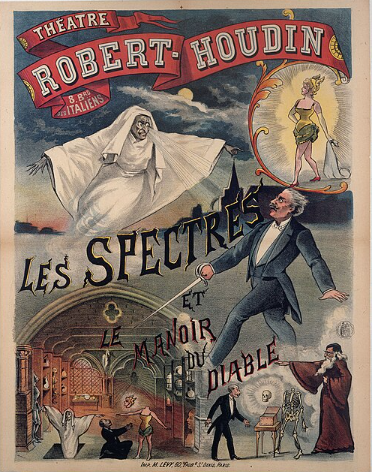
Horror movies have been around since 1896, with the first ever horror movie being called Le Manoir du Diable. It’s about the devil and vampires, but the purpose of this horror movie was not to scare its viewers but to offer amusement and wonderment. Safe to say, horror movies have come a long way since their inception. From their beginnings of amusement to society's deepest fears being depicted. The development of the horror genre is not just a shift in how horror stories are told but how they are directly related to how society consumes media. I will apply Marshall McLuhan's "the medium is the message" to link horror movies and how their depiction of fear is connected to the prevalent media of the time. I will analyze Halloween (1978) and Scream 3 (2000) to establish my argument.
Prevalent Media in the 70's
Halloween (1978)
John Carpenter uses long shots to establish Haddonfield, a safe, quiet neighborhood. We see Laurie walking the streets alone in what is supposed to be that safe environment, but the music invites us to believe that something out of the ordinary is around the corner. - video can be stopped at 1:35
Carpenter uses this scene to depict Laurie being safe inside, but she is being stalked and watched by boogeyman outside, highlighting the way information was consumed, the crime and violence was always something distant. The long shot has Myers far away, it doesn’t seem like he is a real threat, until he disappears, creating tension and suspicion.
Here Laurie is only one to see Myers in the bushes. The camera pans to him for a few seconds which leads to an unsafe and questionable suburban neighborhood. This scene supports the fears that were sensationalised in the 70’s, the stalking, the unknowing victims and the paranoia.
Prevalent Media in the Early 2000's
At the time of Scream 3 (2000) release, our media landscape began to shift towards a more digital, online presence. TV, newspaper and radio were still around and popular, but the internet and magazines began to gain popularity as well. In a study conducted in 2000, the Pew Research Center found that “The Internet has made users more connected to more people, as they can keep in better and more frequent touch with more family and friends, be they old friends or new ones made on the Internet.” The internet allowed for people to stay in touch easier but that connectivity led to more risks, such as being prankcalled, being doxxed or identities being stolen. Identity was even beginning to be questioned, Ghostface takes advantage of this, using voicechangers to deceit his victims. Scream is a good example that showcases this shift in our media consumption, it underlines that the medium is no longer just a broadcast on tv or radio but how media defines our identity and even one's social standing. From unidirectional information in the 70’s to the now bidirectional information, the consumer can both view and produce content. This triggers the blending of consumer to victim. Ghostface steps away from the facelessness and lack of motivated violence. Unlike Myers being an outside threat, Ghostface is an internal one. He is more a performative threat; he quizzes his victims where their knowledge of media is their saving lifeline. Ghostface also highlights how the medium of the internet and modern celebrity culture, anyone can become a killer, especially with the right tools.
Scream 3 (2000)
This is the opening scene to Scream 3. Cotton answers a phone call believing it to be a woman flirting him but it soon turns grisly. Ghostface is on the other end and he uses this call to not only warn Cotton of the danger his girlfriend is in but to get information out of him. Cotton is in danger just by answering the phone. - video can be stopped at 2:51
Sidney stumbles upon the Stab 3 set, which is an exact replica of her neighborhood, home and even memories. This scene shows us when the lines are blurred from consumer to victim. Sidney's reality and the movie retelling the story of her trauma are blended together.- video can be stopped at 2:03
In the end...
From the humble beginnings of pure amusement, horror movies have changed and modernized similar to our media. Not only have they evolved but they go hand in hand. Horror movies that were released almost 50 years ago relied on the sensasionalism of news coverage regarding violence to promote the fears of the viewer. Horrow movies being released now rely on our use of technology to arm the antagonist with our greatest fears of today. Marshal McLuhan states "...we become what we behold." This means that the media we consume not only mirrors our society but it actively shapes it alongiside our identities. Horrow films show us that fear is not constant, it moves and evolves alongside our media and technology.
Citations
Wikipedia Contributors. (2019, October 20). The House of the Devil (1896 film). Wikipedia; Wikimedia Foundation. https://en.wikipedia.org/wiki/The_House_of_the_Devil_(1896_film)
PINEDO, ISABEL. “RECREATIONAL TERROR: POSTMODERN ELEMENTS OF THE CONTEMPORARY HORROR FILM.” Journal of Film and Video, vol. 48, no. 1/2, 1996, pp. 17–31. JSTOR, http://www.jstor.org/stable/20688091. Accessed 20 Apr. 2026.
Part 5. Conclusions. (2004, August 11). Pew Research Center. https://www.pewresearch.org/internet/2004/08/11/part-5-conclusions/
Proton Drive. (2026). Proton.me; Proton Drive. https://drive.proton.me/urls/AHDNCVXDWR#1OwqIEZcME2t